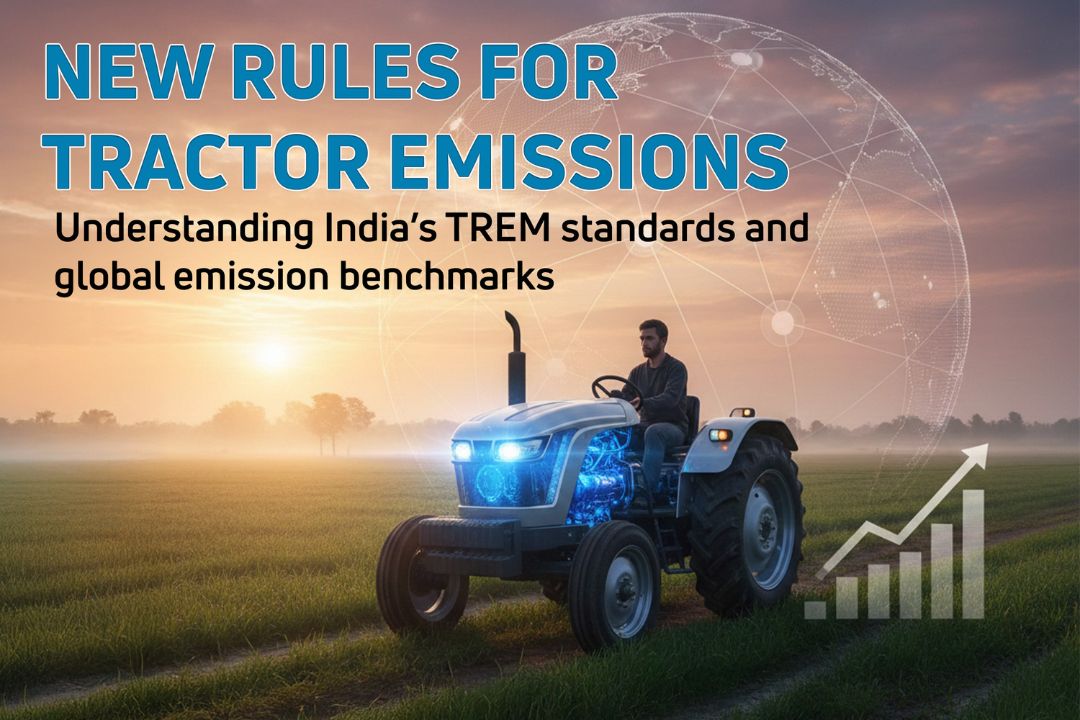

Emission Norms Explained: Indian Tractors vs Global Standards
If you’ve noticed tractor discussions slowly filling up with words like TREM, Stage V, or DPF, you’re not imagining things. Emission rules for tractors in India are changing. For decades, Indian tractors followed a simpler rulebook. Engines were rugged, mechanical, easy to fix and designed mainly for domestic use. Emissions mattered, but they weren’t the top priority. That balance is now changing, driven by cleaner air goals and India’s growing role as a global tractor exporter.
So where do Indian tractors stand today and how close are they to global standards?
A Quick Look at India’s Tractor Emission System
India regulates tractor emissions under something called TREM, short for Tractor and Agricultural Equipment Emission norms. These norms decide how much pollution, mainly particulate matter and nitrogen oxides a tractor engine is allowed to produce.
Right now, India follows a split system. If a tractor is above 50 horsepower, it already falls under TREM IV, which came into effect in late 2022. These tractors use modern engine technologies like electronic fuel injection and exhaust treatment systems such as SCR. They’re cleaner but also more complex.
Most tractors sold in India, however, are below 50 HP. These still run on TREM IIIA engines. Simple, mechanical, cheap to maintain and familiar to farmers.
April 2026: When Everything Changes
From April 1, 2026, India plans to introduce TREM V norms and unlike earlier rules, these won’t stop at a horsepower boundary. That means even sub-50 HP tractors will need advanced emission control systems like Diesel Particulate Filters (DPF). For many models, this is a direct jump from old-school mechanical engines to technology that was unthinkable a few years ago.
How This Compares With Europe and the US
Europe already enforces Stage V norms, which are considered the toughest tractor emission standards anywhere. The US follows Tier 4 Final, which is slightly different in structure but similar in real-world outcomes.
With TREM V, India will effectively match EU Stage V levels. In fact, India will be the first major region outside Europe to adopt Stage V–equivalent rules for tractors across all power categories.
Why Manufacturers Actually Want This
At first glance, stricter norms sound like bad news. More technology, more cost and more complications. But there’s another side to it.
Indian tractors are exported to over 160 countries. Aligning with global standards means manufacturers can build common models for multiple markets instead of redesigning engines for each region. That saves money in the long run and strengthens India’s position as a global tractor hub.
There’s also a technology reset happening. Mechanical fuel systems are giving way to CRDi, DPF and SCR. Engines become cleaner and more efficient but also less forgiving of poor fuel or skipped maintenance.
The Cost Question & Why It Worries Everyone
Industry estimates suggest tractor prices could rise by 15–20%, especially in the sub-50 HP segment. These are the tractors small and marginal farmers depend on the most.
Because of this, bodies like the Tractor Manufacturers Association have asked for exemptions or delayed implementation for certain horsepower ranges, arguing that affordability could take a hit.
What This Means on the Ground
For farmers, cleaner engines are a good thing in theory. Better air quality, modern machines and future-ready tractors.
In practice, though, it also means learning new habits. DPF systems don’t like short, low-load usage. Fuel quality matters more, maintenance can’t be ignored. The “fix-it-yourself” era will slowly fade for newer tractors.
Final Thoughts
TREM V isn’t just another regulation update. It’s India’s tractor industry stepping onto the same stage as Europe and the US. Yes, tractors will get more expensive. Yes, engines will get more complicated. But this also means Indian tractors are being built for the future.
MotorFloor takeaway: Emission norms aren’t just about pollution numbers. They quietly decide how tractors are built, priced and used for the next decade on Indian farms and far beyond.

MotorFloor
Articles: 33Related Posts
Best Tractor Practices for Small-Land Farmers in India
When Is the Right Time to Buy a Tractor: Astrology Secrets Revealed
Common Tractor Problems During Indian Summers & How to Prevent Them
How to Change a Tyre Puncture on a Tractor: A Step-by-Step Guide
Best Tractor Settings for Paddy, Sugarcane, Wheat & Cotton Farming