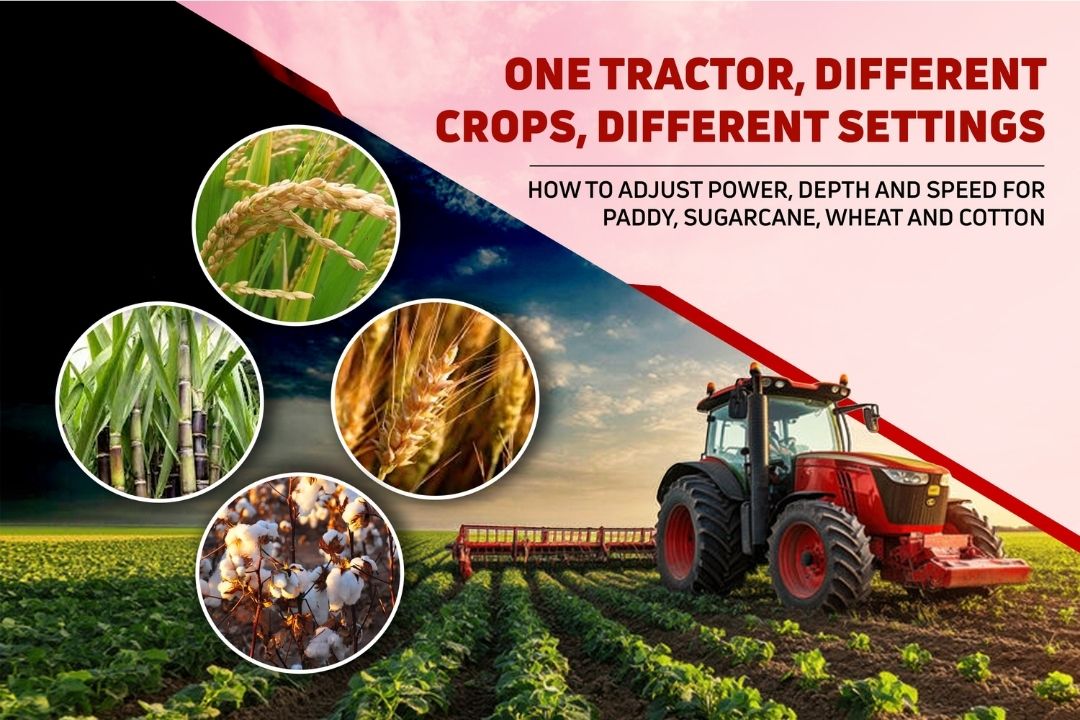

Best Tractor Settings for Paddy, Sugarcane, Wheat & Cotton Farming
Indian farming does not follow a single approach for farming of different crops. The way a tractor works in a flooded paddy field is completely different from how it’s expected to perform in dry wheat land or deep sugarcane furrows. That’s why tractor settings matter as much as tractor power. Using the same tractor settings for different applications results in loss of fuel, soil damage and uneven sowing.
Below is a crop-wise look at how tractor power, speed, depth and hydraulics should be adjusted for four major Indian crops.
Paddy (Rice): Built for Wet and Slushy Fields
For most paddy farms, 21–35 HP tractors work well, especially compact or utility models. On slightly larger holdings or when using rotavators, tractors up to 50 HP are common. 4WD is strongly preferred because it provides steady grip in slush.
Puddling and sowing should be kept shallow. Ideal sowing depth is 3–5 cm, while direct seeding equipment usually runs even shallower at 1–3 cm. Operating speed needs to stay slow and controlled, typically around 1.8–2.25 km/h to avoid soil disturbance.
Lower tyre pressure helps increase the footprint and prevents sinking which is critical in wet fields.
Sugarcane: Heavy Work, Deep Soil
Most sugarcane farms use tractors in the 45–60 HP range, while larger holdings or deep sub-soiling operations may go up to 75 HP. High torque is more important than speed here.
Deep tillage is common, often reaching 40–60 cm, especially when breaking hardpans using sub-soilers (usually around 45–50 cm). For planting, furrows should be set deeper at 20–25 cm, particularly in ridge-and-furrow systems.
Here, steady pulling power and strong hydraulics reduce repeated passes and make haulage easier during harvest.
Wheat: Precision and Uniformity Matter
Tractors in the 45–50 HP range are standard for wheat cultivation. A 540 RPM PTO is sufficient for seed drills and basic implements. Sowing depth should stay between 3–5 cm, ensuring quick germination.
Operating speed for seed drills is usually 2.6–2.8 km/h, allowing proper seed placement without bounce. Row spacing is generally maintained at 20–22.5 cm for optimal crop stand.
Tyre pressure should remain standard to avoid soil compaction on dry land.
Cotton: Flexibility Is Key
Most cotton farms operate comfortably with 35–55 HP tractors. Strong hydraulics with a lifting capacity of 1,500–2,000 kg are important for ridge makers and heavy cultivators.
Sowing depth remains similar to wheat at 3–5 cm but row spacing varies widely. Some varieties work at 20–30 cm while others need up to 60 cm spacing to allow inter-cultivation.
Multi-speed PTO options help when switching between sprayers, cultivators and other cotton-specific implements.
Settings That Matter Across All Crops
Automatic Depth and Draft Control (ADDC) should be used whenever possible to maintain consistent working depth. This improves uniformity and reduces operator fatigue. Tyre pressure must always be adjusted based on soil condition, lower for wet fields, normal for dry crops.Motorfloor takeaway: Different crops demand different tractor behaviour. Adjusting power, depth, speed and hydraulics crop by crop does more for productivity than simply owning a bigger tractor.

MotorFloor
Articles: 33Related Posts
Best Tractor Practices for Small-Land Farmers in India
When Is the Right Time to Buy a Tractor: Astrology Secrets Revealed
Common Tractor Problems During Indian Summers & How to Prevent Them
How to Change a Tyre Puncture on a Tractor: A Step-by-Step Guide

Top Mistakes Farmers Make While Buying a Tractor & How to Avoid Them