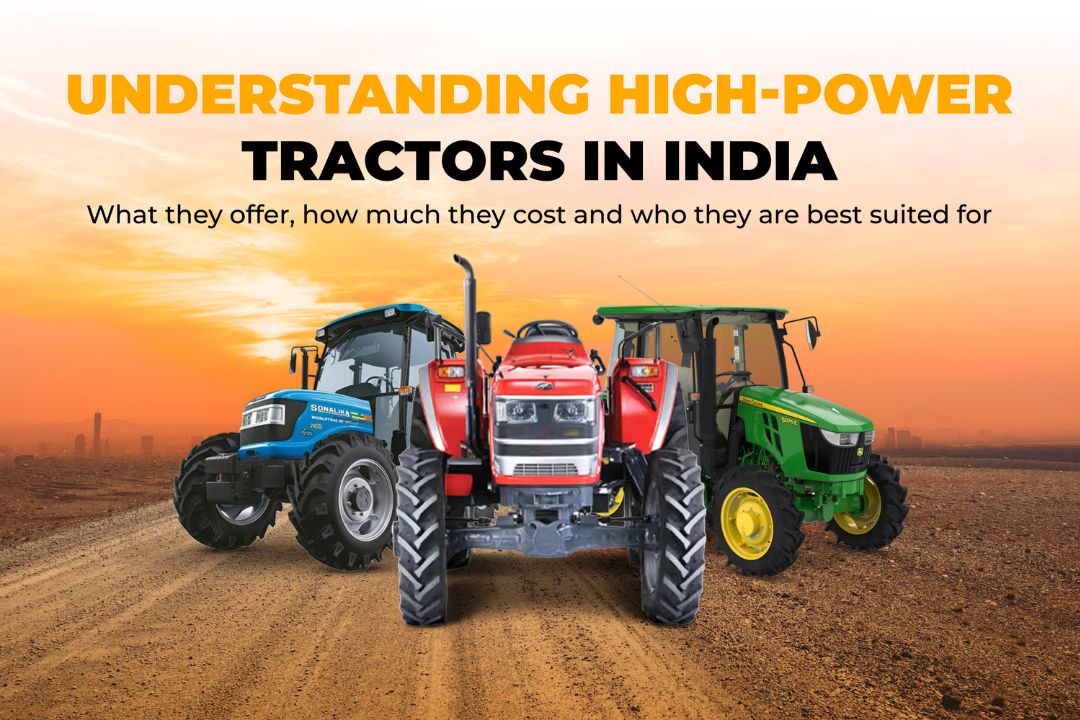

High-Power Tractors in the Indian Market. And Who Really Needs Them
High-power tractors get talked about a lot these days. Walk into any big dealership and you’ll hear numbers like 90 HP, 110 HP and even 130 HP being used for tractor power. For some farmers, these machines are exactly what’s needed. For others, they’re expensive overkill that never really gets used to full potential.
In India, a tractor usually enters the high-power category once you cross roughly 75 HP. From there onwards, the machines are built differently. Heavier chassis, bigger tyres, stronger hydraulics and engines designed to pull hard for long hours without struggling.
At present market rates, 75–90 HP tractors usually sit somewhere between ₹13 lakh and ₹17 lakh. Once you move into 100 HP and above, prices easily climb into the ₹18–25 lakh range, sometimes more depending on features like transmissions, cabins or electronics. This alone should make any buyer pause and ask a simple question: “Do I really need this much tractor?”
Large landholders, say 15 acres and above or those running commercial operations often need to finish work fast. When sowing, harvesting or land preparation windows are tight and speed matters. Bigger tractors pull wider implements, cover more area in less time and reduce the number of days machines stay in the field.
Then there are the implements. Big rotavators, multi-bottom ploughs, balers, heavy trolleys and forage harvesters, these don’t work properly behind smaller tractors. They need PTO power and lifting capacity that only higher-HP machines can deliver comfortably.
That’s where tractors like the John Deere 5130 M come in. At around 130 HP, it’s meant for serious work. With close to 120 PTO HP and a lifting capacity nearing 3700 kg, it’s the kind of tractor that doesn’t flinch when paired with large implements. It’s also built for long days, which matters more than people admit.
The New Holland Workmaster 105 TREM IV 4WD sits slightly lower on the power scale but is still firmly in high-power territory. Around 106 HP, strong hydraulics and features like power shuttle make it popular for loader work, tillage and uneven land. Farmers who do mixed operations often lean toward this kind of balance.
At the lower edge of this segment is the Mahindra NOVO 755 DI. At 74 HP, it’s not massive, but it’s powerful enough for hard soil, mulchers and power harrows. Many farmers see it as the point where tractors stop being general purpose and start becoming truly heavy-duty.
The Sonalika WorldTrac 90 Rx 4WD is another example. With 90 HP, strong PTO output and a solid build, it’s often used where hauling and long hours are common. Comfort features matter here, because these tractors are rarely parked.
But here’s the part dealers don’t always say clearly: high-power tractors don’t automatically mean better farming.
If your land is small, your implements are modest and your tractor spends more time idling than pulling, a big engine just burns more diesel and increases maintenance costs. Bigger tractors also compact soil more and need more space to operate efficiently.
High-power tractors make sense when:
- land is large
- implements are heavy
- terrain is difficult
- or the tractor earns money beyond the farm
Outside of that, they’re often underused.
Motorfloor takeaway: High-power tractors are tools, not trophies. They pay off only when the scale of work demands them, otherwise, they’re just expensive horsepower sitting in the yard.

MotorFloor
Articles: 33Related Posts
Best Tractor Practices for Small-Land Farmers in India
When Is the Right Time to Buy a Tractor: Astrology Secrets Revealed
Common Tractor Problems During Indian Summers & How to Prevent Them
How to Change a Tyre Puncture on a Tractor: A Step-by-Step Guide
Best Tractor Settings for Paddy, Sugarcane, Wheat & Cotton Farming